The Challenge
Local news is dying for a reason that has nothing to do with demand. People still want to know what happened at the Legislature, whether the surf is up, and which road is closed. What collapsed is the economics. A newsroom covering seven beats across a group of islands needs reporters, editors and a publishing operation, and local advertising has not paid for that in twenty years.
The brief was to build an outlet that covers Hawaii daily across politics, weather, sports, crime, business, local news and island life, and to run it without a newsroom. That is not a content problem. It is a systems problem, and every part of the chain has to work unattended: finding the story, writing it, optimising it, publishing it, linking it, sending it out and sharing it.
Any single broken link in that chain means someone opens a laptop every morning, and the whole model stops working.
What We Built
The pipeline runs on WP Automatic and Make with OpenAI doing the writing. RSS feeds bring in source material, Make routes it through the generation step, and the finished article is pushed into WordPress under the right category with everything it needs already attached.
The SEO happens inside the pipeline rather than after it. Rank Math meta fields are written through the API as part of the same scenario, so every article publishes with a title tag, a meta description and a focus keyword rather than with the defaults that most automated sites never go back and fix. Featured images get alt text generated alongside the article, which is the step everyone skips and Google notices.
Internal linking was the hardest part to solve and the most valuable. Rather than linking at random, the scenario pulls recent posts filtered by category and links each new article into the ones it actually belongs with, so a politics story connects to politics coverage. That is what turns a stream of unconnected posts into something search engines read as a publication with depth on a subject. Automated sites almost never have it, and it is a large part of why they plateau.
Seven author personas run across the seven beats, so a weather story and a crime story do not read as if the same voice wrote both. Consistency of voice within a section matters more on a news site than variety across it.
Distribution is automated on both ends. New posts push to the connected social platforms with their links and images already attached, and the newsletter sends automatically with summaries of what published. Most automated content projects stop at publishing, which means the articles sit waiting for Google and nothing else. Here the article goes out to the audience the moment it exists.
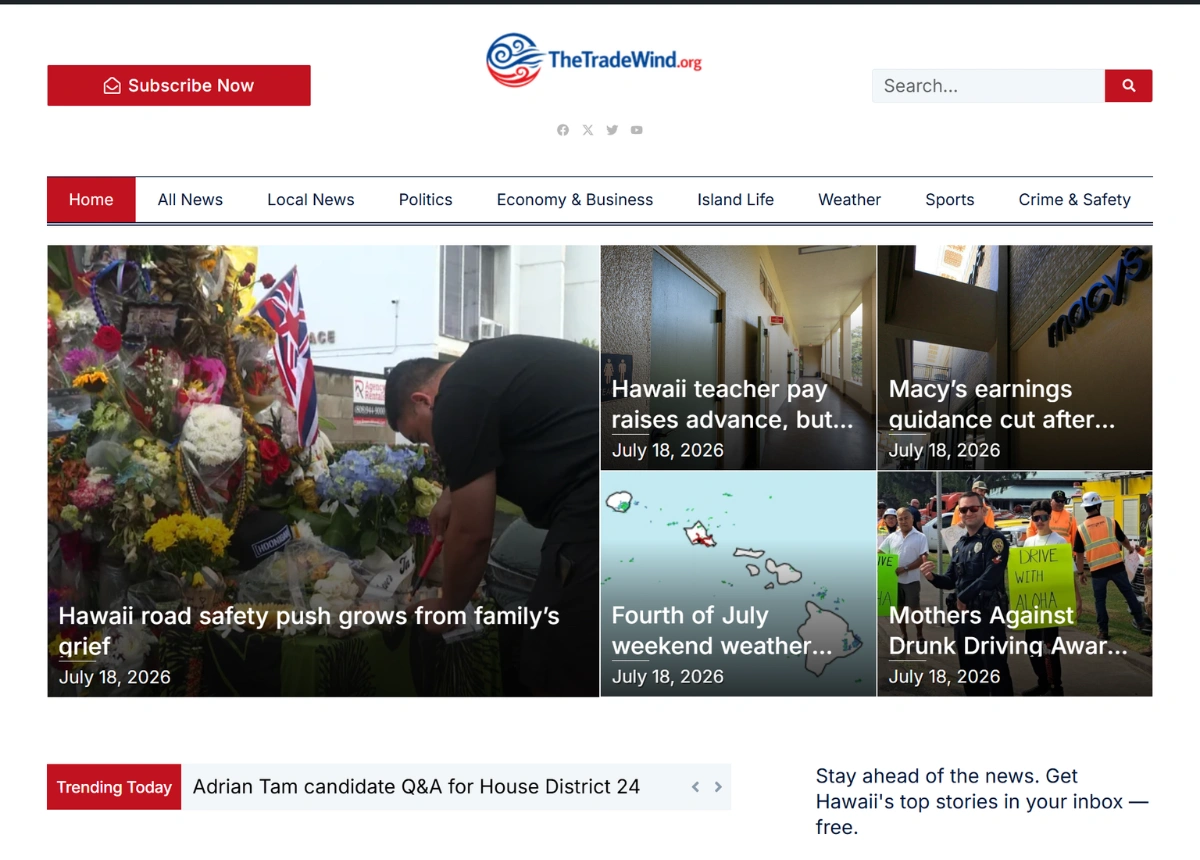
The front end was built to absorb whatever volume arrives. Seven category sections on the home page, a trending block, a recent news column, and a long more news list, all filling themselves. Whether the pipeline delivered four stories today or fourteen, the page looks like a working news site. Two newsletter blocks sit inside the flow, one mid page and one in the footer, because on a news site the reader who came for one story is the one worth capturing.
Where the Work Actually Is
Once a system like this runs, nobody touches the publishing. The work moves to what the pipeline is pointed at and what it is allowed to publish, and that is the only decision left that changes what the site becomes.
Everything downstream of that decision, the writing, the meta, the images, the linking, the newsletter, the social posts, happens without anyone present.