The Challenge
Fiore Lifestyle sells silk kimonos at $349 and kaftans at $299. Francesca founded the label around a Balinese and European fusion, and the pieces are made in small runs rather than produced at volume, which is why they cost what they cost.
That price is the whole problem. A customer who has never heard of the brand is being asked to spend three hundred dollars on a garment she cannot touch, from a label with no store to walk into. Fast fashion sells the same silhouette for forty. Everything on the site had to close that gap, and no amount of product photography does it alone.
There was a second thing to solve. At these prices most customers buy one piece and leave, which makes each order expensive to win and small once won.
What We Built
The founder is on the home page by name. Francesca appears with her story rather than as a footnote on an about page, because a small label competing against volume brands is selling a person and a point of view. Anonymous brands cannot charge $299 for a kaftan. Named ones can.
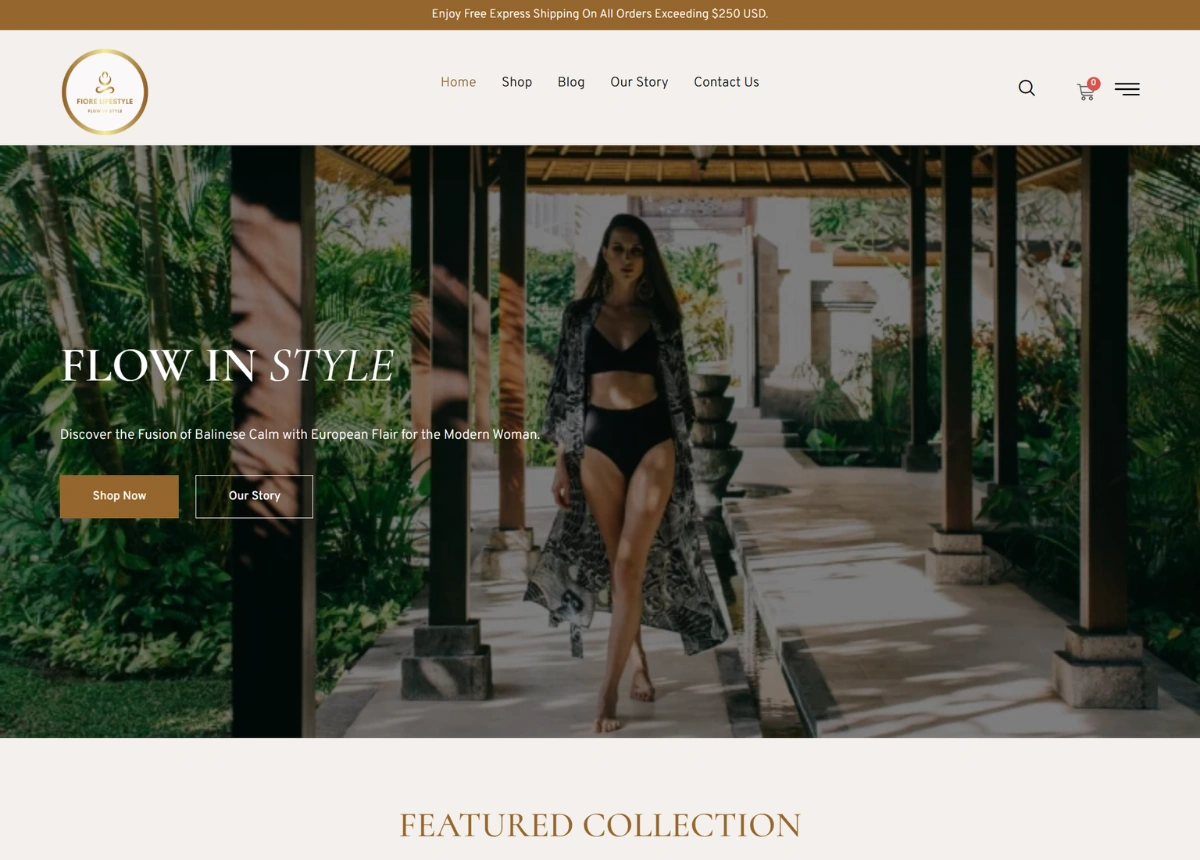
Free express shipping starts at $250, announced in a bar above the header on every page. That number was chosen against the catalogue rather than picked round. Ponchos sit at $99 and $139, skirts at $78, pants at $110 and $120. A single mid-priced piece lands short of the threshold and two clear it comfortably, so the offer does its work at the exact moment a customer is deciding whether to add a second item.
Categories are split by garment type, with Kimonos and Kaftans, Beach Ponchos, Jewelry, and Tops and Pants each getting a collection tile. Angel Wing was pulled out and given its own place as the best-seller collection instead of being buried inside kimonos, so the pieces that already convert are the ones a first-time visitor meets first.
Variable products carry price ranges on the listing, $289 through $349 on the classic silk kimono and $99 through $119 on the feather earrings, so a customer sees where a piece starts before opening it. Hiding that until the product page costs clicks from people who would have bought.
Trust markers sit in a row after the story: ethically made, women-owned, a happiness promise, secure payment. On a premium purchase from an unfamiliar label, ethical production is not decoration. It is a large part of what the customer is paying the difference for, and it needs to be visible before the price is.
The blog was built as a lifestyle publication rather than a product feed. Posts cover a Bali wellness retreat and Balinese-Italian recipes alongside styling. The brand sells a way of living, and content about food and travel reaches the woman who would buy a $299 kaftan far better than another article about kaftans would.
Running the Store
Products, categories and promotions are all managed from WooCommerce, so a seasonal sale like thirty percent off clothing is a settings change rather than a design job.
The layout holds whether a category has four pieces or forty, which matters for a label releasing in small runs where collections shrink as things sell through.