The Challenge
Chaze was launching a children’s apparel brand in the US, and children’s clothing has an economic problem that adult clothing does not. A child outgrows everything in four months. That makes retention the entire business rather than a nice extra, because a parent who buys once is guaranteed to need to buy again, and winning that same customer twice costs almost nothing compared to finding a second one. Most kids’ stores are still built as though every visit is a first visit.
The second problem was where parents actually find children’s products now. They are not searching Google for pyjamas. They are watching a TikTok, tapping a product tag on Instagram, and buying inside the app they were already in. A store that only sells from its own website is invisible to most of that traffic.
And launching with inventory would have meant betting money on which designs sell, in a category where character licences and seasonal taste turn over constantly. Chaze needed to be able to test designs without owning any of them.
What We Built
Fulfilment runs on Printful, so nothing is produced until it sells. A design goes up, it either moves or it does not, and the ones that fail cost nothing but the time spent making them. For a new label in a trend-driven category, that single decision removes the risk that ends most first years.
Products sync out to Instagram, TikTok and Facebook shops from the same WooCommerce catalogue. Prices, stock and images stay consistent across all four storefronts because they all come from one source, and a parent can buy without ever leaving the app they were scrolling. Running four shops by hand is not possible for one person, which is why most small brands end up with an abandoned Instagram shop still showing last season’s prices.
A points and rewards system handles retention. Customers earn on every order and spend on the next one, which suits this category better than almost any other. In most stores loyalty points are a discount wearing a costume. In children’s clothing the next purchase is genuinely coming in a few months, and points give the parent a reason to make it here instead of wherever the next ad finds them.
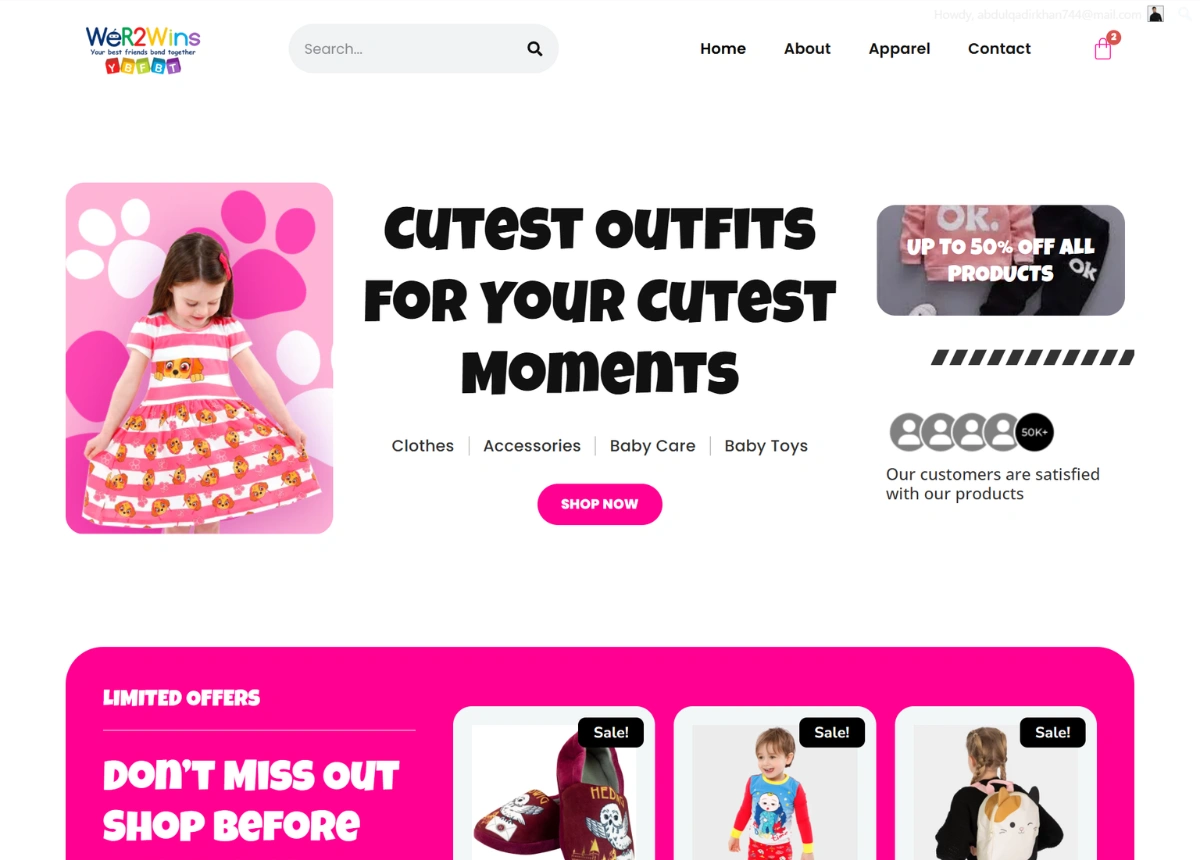
The catalogue splits two ways at once. By product type across clothes, accessories, baby care and toys, and by collection for boys and girls. Parents navigate differently depending on why they arrived. Someone who needs pyjamas today shops by type, someone buying a birthday gift shops by collection, and every product sits in both paths without being duplicated.
Urgency sits high on the page, with a countdown block on limited offers and sale pricing showing struck-through originals, $15 down to $9 on slippers and $23 down to $15 on a backpack. Children’s clothing is an impulse category at these prices. A parent who leaves to think about a $9 pair of slippers does not come back.
A newsletter offering 20 percent off the first order catches the visitor who was not ready today, and together with the points system it forms the whole repeat-purchase engine: one mechanism to get the first order, another to get the fourth.
The Design
Bright pink, cyan and black, rounded shapes, and a heavy playful typeface. Children’s stores usually go pastel and soft, which reads as calm and forgettable. This one runs loud deliberately, because the products are loud, and because a large share of the traffic arrives from TikTok where a muted palette simply disappears in the feed.
Product cards stay identical across every section of the site, so a seasonal drop or a new collection slots in without a layout being touched. Chaze adds products, and the store absorbs them.